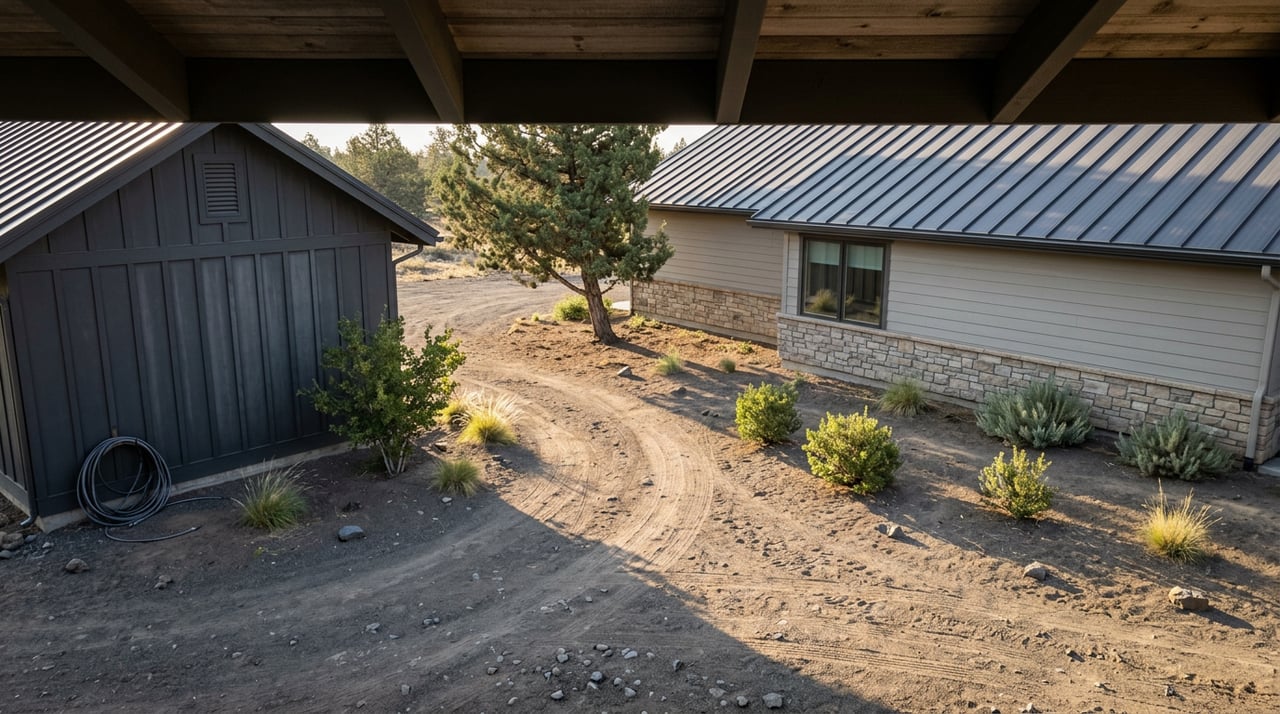
Selling a Powell Butte Home With a Well: What to Know
August 27, 2026
August 27, 2026
Most sellers in Powell Butte treat their well and their septic system as a matching set. Both are private infrastructure. Both get mentioned in the same breath during a walkthrough. Both feel like the kind of thing a buyer's inspector will "handle."
Oregon law disagrees. One of those systems is a legal obligation with a state reporting deadline attached to it. The other is optional, no matter how many buyers ask for it. Sellers who don't know which is which tend to find out at the worst possible moment: mid-transaction, with a closing date already on the calendar.
Under Oregon's Domestic Well Testing Act, codified as ORS 448.271, a seller who accepts an offer on a property served by a domestic well has a legal duty to test that well for arsenic, nitrates, and total coliform bacteria. The seller then has to send the results to the buyer and to the Oregon Health Authority within 90 days of getting them back from the lab. This isn't a courtesy disclosure. It's a statute, and it names the state health authority as a recipient, not just the person buying the house.
There are exemptions worth knowing if your Powell Butte property leans toward the land side of the business: properties served by spring wells, irrigation-only wells, or a well sitting on undeveloped land fall outside the rule. That matters for anyone selling acreage before a home gets built on it, since the obligation attaches to domestic use, not to the presence of a well casing in the ground.
The septic side works differently. Oregon's Department of Environmental Quality is explicit that septic system evaluations are voluntary statewide. There's no comparable statute forcing a pre-sale inspection. If a seller does choose to have one done, the evaluator has to use the state's approved Existing System Evaluation Report form, but choosing to skip it entirely breaks no law.
In practice, this gap gets papered over by the market rather than the legislature. Buyers ask for a septic evaluation anyway. Lenders often want one in the file before they'll fund. Real estate contracts in Central Oregon typically route the well obligation through a standard document, the Oregon REALTORS Well Addendum, which spells out the testing requirement and the 90-day reporting window right in the purchase agreement. The septic side usually gets negotiated as a buyer contingency instead.
The reason this distinction bites harder in Powell Butte than in a lot of Central Oregon has to do with what's actually under the ground there. According to a local well drilling company that has worked the area for decades, Powell Butte Mountain sits on a core of clay that predates the Cascade Range itself. When groundwater started moving through the region, it flowed around that hard clay rather than through it, which is why wells on and near the butte tend to hit water at shallower depths but at a much slower rate of flow than wells elsewhere in the county.
The practical result is a well that trickles rather than gushes. To make that trickle livable, a lot of Powell Butte properties pair their well with a large storage cistern, often in the range of 20,000 gallons, that the pump fills around the clock so the household has enough water on hand for daily use. It's a completely normal setup for the area, but it changes how a pre-sale water test should be planned.
A slow-yield, cistern-buffered system doesn't fill a sample bottle the same way a high-output well does, and coordinating that collection with a lab's hold times for bacteria samples takes a little more lead time than a straightforward pump-and-tap setup. Waterlab Corp, an accredited lab that tests Powell Butte properties for Crook County sellers, notes that same-day processing is available for bacteria samples if they arrive before noon, but that only works if the sample gets collected and shipped without last-minute scrambling. On a slow well, that scramble starts earlier than sellers expect.
Here's where the stakes stop being theoretical. According to Central Oregon Daily, the Oregon Health Authority's Environmental Health Assessment Program published a health consultation report in June 2026 on domestic wells sampled in fall 2024 and spring 2025 in an area north of Prineville, in the same county as Powell Butte. Of the 58 wells tested, nearly all came back with arsenic levels high enough to warrant treatment or a different water source, and seven also showed manganese levels considered risky for infants. About half the wells had detectable lead, which the report traced to household plumbing rather than the source water itself. Public comment on the findings closed August 17 of this year.
That report sits at odds with something you'll find on more than one local well-drilling company's own FAQ page: a claim that arsenic simply "doesn't occur" in Central Oregon groundwater. The state's own recent testing in a Crook County location says otherwise. Neither claim is wrong out of malice. One is decades of anecdotal field experience. The other is a lab result from samples drawn in 2024 and 2025. But it's exactly the kind of gap that makes a mandatory, individually-tested requirement more useful than a reputation.
Zooming out to the county level, Tap Water Data gives a modeled estimate built from USGS groundwater data that puts the likelihood of an elevated arsenic reading across Crook County as a whole at around 7 percent, with the most probable concentration category sitting under 5 micrograms per liter, below the EPA's health-based limit of 10. That's a reasonably reassuring county-wide number, and it comes with an important caveat built into the model itself: an area-wide estimate says nothing about any one well, which can run well above or well below that average depending on depth, geology, and what's happening on neighboring parcels. The same data source notes that Crook County has essentially no row-crop farmland, which is one reason nitrate risk tends to track lower than arsenic risk countywide, though a poorly sited septic drain field on an individual property can still push nitrate up regardless of what the county average says.
Put together, this is the case for treating your own well's test results as the only number that matters, not the reassurance of a countywide average or a driller's general sense of the area.
Here's what this looks like in practice for a Powell Butte listing:
Does the well test have to happen before I list the house, or only after I accept an offer? The statute's obligation triggers on accepting an offer, not on listing. Nothing stops a seller from testing earlier as a way to get ahead of buyer questions, and on a slow-yield Powell Butte well, that head start is often worth taking.
What actually happens if a seller never gets around to the well test? Failing to comply leaves a missing piece of documentation that a lender may flag.
Is a septic inspection ever legally required in Oregon? Not statewide. It remains voluntary under DEQ rules regardless of price point or property type. The reason it feels mandatory in practice is that buyers, their agents, and their lenders have made it a standard expectation, not because a statute requires it the way ORS 448.271 requires well testing.
Powell Butte rewards sellers and buyers who know which rules are actually rules and which are just strong local habits. If you're getting ready to list a well-served property here, or you're looking at acreage and trying to sort out what a well log actually tells you before you make an offer, Brent Krebs Realty has spent years working these exact transactions in Crook County. Schedule a consultation before your timeline gets tight, not after.
This article is general information, not legal, tax or financial advice. Consult a qualified professional about your situation.
Stay up to date on the latest real estate trends.
Whether you’re buying your first home or selling a property, Brent Krebs Realty is here to help. We combine local insight with a client-first approach to deliver results that matter.